

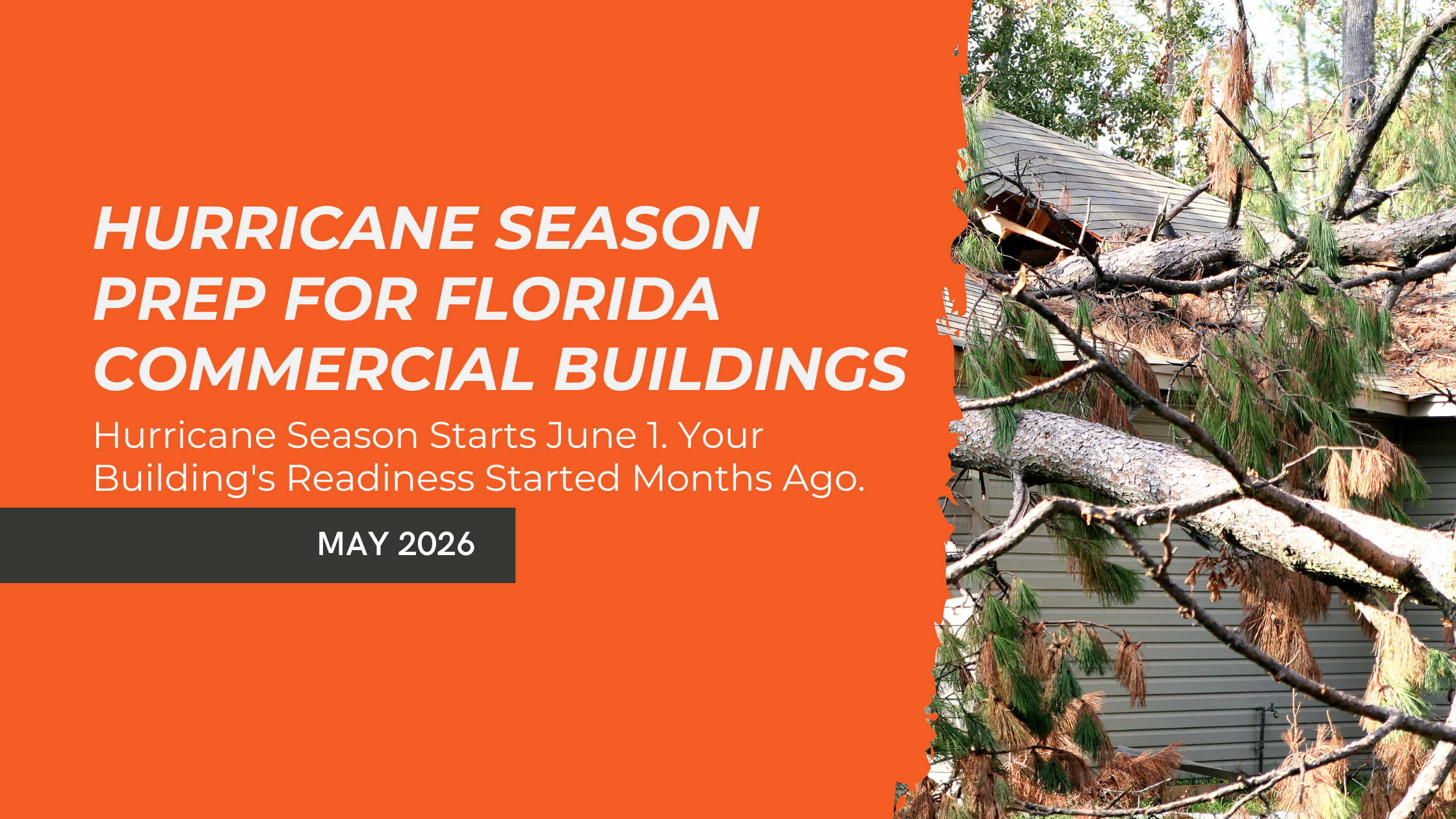
Hurricane Season Prep for Florida Commercial Buildings
Hurricane Season Starts June 1. Your Building’s Readiness Started Months Ago.
Hurricane season officially begins June 1, and the National Hurricane Center tracks Atlantic activity throughout the season. For Florida property managers, that calendar date matters less than what’s already been done, or not done, to the building.
The properties that come through a storm in the best shape aren’t the ones that scramble in late May. They’re the ones where maintenance has been steady all year. By the time a storm forms in the Gulf, the work that protects the building is either done or it isn’t.
What hurricane prep actually looks like
The standard hurricane checklist circulates every spring. Clear the drains. Inspect the roof. Trim the trees. Test the generator. It’s not wrong, but it treats hurricane prep as a one-time event in May, when most of those items should be on a regular maintenance schedule anyway.
A roof that hasn’t been inspected since last hurricane season is a roof you don’t actually know the condition of. A drain that clears in a normal afternoon storm may not handle six inches in two hours. A generator that started last September might not start this June.
The point of preventative maintenance is that you find these problems on a normal Tuesday, not the day before a storm.
The items that matter most for commercial buildings
Some maintenance items have a direct relationship to storm performance. These are the ones worth confirming in the next two weeks:
- Roof condition. Loose flashing, soft spots, lifted edges, and clogged scuppers are common findings. Most are easy fixes when caught early. They become expensive when caught after a storm.
- Drainage. Roof drains, parking lot drains, and downspouts all need to move water fast. Standing water during a hurricane means standing water inside the building.
- Exterior fixtures. Loose signage, light fixtures, awnings, and rooftop units become projectiles in 70+ mph winds. Anchoring needs to be checked, not assumed.
- Doors and windows. Weather seals fail quietly. Failed seals turn into water intrusion the moment wind drives rain sideways.
- Tree clearance. Branches near the roof, near power lines, or near windows are the easiest single risk to reduce before a storm.
None of this is a hurricane-specific service list. It’s a reasonable maintenance baseline that becomes urgent if it hasn’t been done.
What property managers tend to miss
The items above get attention because they’re visible. The ones that get missed are usually the ones that only matter during or after a storm.
Backup power is the most common one. A generator that runs for ten minutes during a monthly test is not the same as a generator that runs for 36 hours straight. Fuel quality, transfer switch function, and load testing matter more than the start-up itself.
Communication infrastructure is another. If a building’s primary power goes out, do the alarm panels, access controls, and emergency lighting all transition cleanly? That’s something to test before June, not during.
And documentation. After a storm, insurance claims move faster when the building’s pre-storm condition is documented. Photos, inspection reports, and recent maintenance records make the difference between a clean claim and a six-month dispute.
The benefit of a maintenance partner during storm season
When a storm is forming in the Gulf, the property managers who handle it best are usually the ones who aren’t trying to find a vendor for the first time. The relationships, the building knowledge, and the response protocols are already in place.
That’s true year-round, but it’s most visible during hurricane season. A maintenance partner who already knows the building doesn’t need to be briefed on where the roof drains run, which units serve the lobby, or which access points need to be secured. The work starts faster because the context is already there.
For multi-property portfolios across Florida, that consistency matters even more. A storm rarely hits one location in isolation. Coordinated response across regions is something you set up before a season, not during one.
What to do before June 1
If hurricane prep isn’t already underway, the next two weeks are the window. A practical short list for the lead-up:
- Walk the roof, or have it walked. Document the condition.
- Confirm all drains are clear and flowing.
- Inspect and tighten any exterior fixtures that could come loose.
- Test the generator under load, not just on idle.
- Update emergency contact lists and confirm vendor availability.
- Photograph the property’s current state for insurance reference.
This is the baseline. Anything beyond it depends on the specific building, location, and recent maintenance history.
The point isn’t that hurricane season changes how a building should be maintained. It’s that hurricane season exposes whether it has been.
IMS works with property managers across Florida on year-round maintenance, including the work that quietly determines how a building performs during storm season. If your portfolio could use a second look before June 1, that’s the kind of conversation worth having now.
Contact the IMS Team today to get started.